Wearable Biometrics: Sensor Arrays and Signal-to-Noise Realities
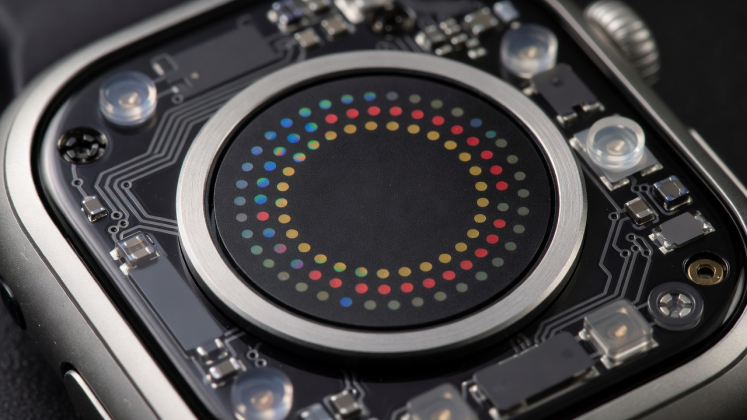
Modern smartwatches and connected fitness rings have evolved into sophisticated multispectral laboratories worn continuously against human skin. Beneath their ceramic backplates sits a cluster of alternating green, red, and infrared Light Emitting Diodes (LEDs) paired with sensitive photodiodes.
This methodology—optical photoplethysmography (PPG)—measures volumetric variations of blood flow within microvascular beds. Green wavelengths penetrate the epidermal layer to capture cardiac pulse intervals and pulse rate variability, while red and infrared ratios calculate blood oxygen saturation (SpO2) based on differential absorption curves of oxygenated versus deoxygenated hemoglobin. Concurrently, micro-electrodes measure electrical potential across the skin to generate single-lead electrocardiogram (ECG) waveforms and detect galvanic skin responses.
The engineering challenge lies in separating minuscule biological signals from heavy motion artifacts. Running, typing, or loose strap tension introduces mechanical vibration noise that dwarfs the photodiode voltage shift. Advanced DSP firmware applies recursive Kalman filters and accelerometer cross-referencing in real time to isolate authentic pulse intervals from biomechanical vibration.
Domestic Robotics Navigation: From Bumpers to Solid-State Lidar
The progression of consumer domestic robotics—predominantly autonomous vacuum and mopping systems—mirrors the history of autonomous vehicles on a micro scale. Early systems relied on mechanical bumper switches and random pseudo-bounce patterns, resulting in erratic cleaning cycles and poor room coverage.
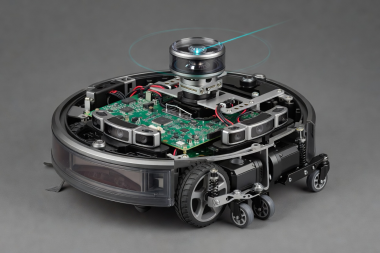
Contemporary units deploy Simultaneous Localization and Mapping (SLAM) powered by mechanical spinning or solid-state optical lidar (Light Detection and Ranging) modules. A focused laser diode pulses thousands of times per second; by calculating the precise time of flight (ToF) for photon reflection, the robot constructs a millimetre-accurate two-dimensional point-cloud map of interior architecture.
To address objects below the lidar horizon—such as charging cables, pet waste, or discarded slippers—modern robotics combine lidar with front-facing stereoscopic camera arrays and structured infrared light projectors. Onboard NPUs run lightweight convolutional neural networks that identify hazards down to 5 millimetres in height, dynamically calculating deviation paths around obstacles while preserving room coverage efficiency.
Spatial Floorplans and Data Governance Risks
The cartographic output generated by autonomous cleaning robots represents some of the most sensitive spatial metadata ever collected in private homes. A comprehensive SLAM floorplan reveals the precise square footage, room boundaries, furniture configurations, and presence patterns of an entire household.
When cloud-dependent robotics vendors upload raw SLAM point clouds and visual obstacle snapshots to external data centers, security hazards escalate. Several high-profile industry incidents have highlighted human annotation contractors reviewing domestic camera feeds captured from floor-level perspectives.
Consequently, privacy-focused users are adopting firmware alternatives such as Valetudo. Valetudo strips vendor cloud binaries from supported robotic hardware, replacing them with a local web interface and MQTT bridge. The vacuum operates completely offline, storing its floorplans strictly in local flash memory and communicating directly with Home Assistant over local Wi-Fi without transmitting architectural floorplans to remote corporate clouds.
Next Horizons: Smart Glasses and Micro-Displays
In personal wearables, smart glasses are transitioning from clunky novelty devices toward refined, all-day optical frames. By integrating waveguide optics, microLED projection engines, and ultra-directional bone conduction or acoustic wave transducers into lightweight titanium temples, current designs present contextual heads-up navigation and transcription notifications without obscuring peripheral vision.
Balancing thermal dissipation against battery longevity remains the fundamental physical constraint: placing lithium-polymer chemistry and high-speed radios adjacent to the wearer's temples restricts continuous processing power to low-duty cycles, necessitating tight offloading coordination with companion smartphone host processors.