Ambient Sensing: Beyond Passive Infrared (PIR) to Micro-Doppler Radar
For decades, domestic occupancy automation relied exclusively on Passive Infrared (PIR) sensors. PIR sensors suffer from severe intrinsic limitations: they detect only relative thermal displacement across optical fresnel segments. When a room occupant sits motionless at a desk reading or working on a laptop, PIR sensors register no delta, falsely reporting an empty room and prematurely shutting off lighting and heating zones.
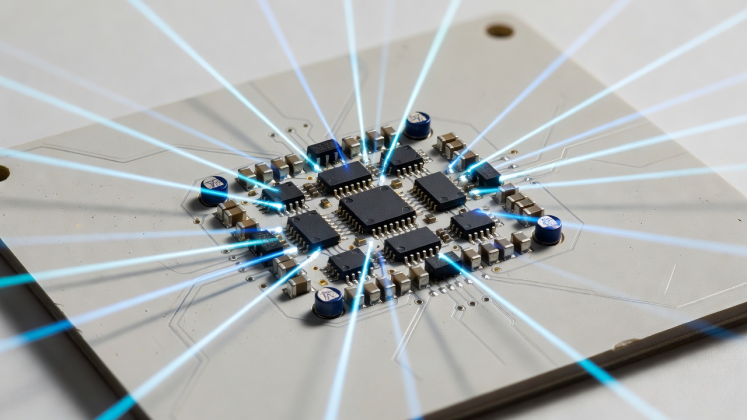
The replacement architecture is millimetre-wave (mmWave) radar operating at 60 GHz to 64 GHz frequencies. Unlike thermal sensors, mmWave transceivers emit high-frequency radio pulses and calculate minute micro-Doppler shifts in returned phase signatures.
This precision allows mmWave presence detectors to track sub-millimetre chest deflections caused by human respiratory cycles. Even if an occupant remains perfectly stationary, the sensor maintains positive presence identification. Furthermore, multi-antenna beamforming configurations allow spatial zoning: a single ceiling-mounted mmWave node can distinguish between someone sitting on a sofa versus an occupant seated at an adjacent dining table, firing distinct automation routines without requiring intrusive optical cameras.
Energy-Harvesting Ambient IoT: Batteryless Sensors
A severe operational bottleneck in extensive smart home and facility deployments is battery maintenance. A residence with 80 connected contact sensors, radiator valves, and switches requires continuous battery replacements, generating recurrent electronic waste and manual maintenance burdens.
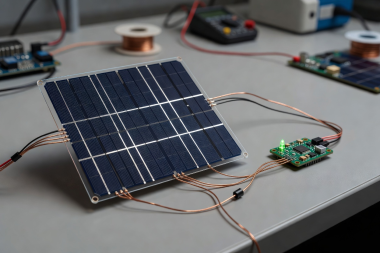
Emerging ambient IoT protocols are resolving this barrier through ultra-low-power silicon capable of operating entirely on harvested ambient energy. By utilizing miniature indoor photovoltaic cells optimized for fluorescent and LED spectra, thermoelectric generators harvesting heat differentials across radiator pipes, and kinetic piezo-electric rocker switches, these nodes operate with zero battery cells.
Coupled with low-power radio standards such as Thread and EnOcean, these devices wake up in response to mechanical actuation or periodic ambient energy thresholds, broadcast a secured state payload, and return to an unpowered state within single-digit milliseconds. The outcome is indefinite operational longevity built directly into physical structural materials.
Spatial Computing Optics: Surface Waveguides and MicroLEDs
Spatial interfaces represent the migration of digital user interfaces from flat glass touchscreens into physical three-dimensional space. The engineering challenge in optical head-mounted displays has always been optical efficiency, field of view (FOV), and physical bulk.
Emerging designs deploy diffractive surface-relief waveguides etched onto high-refractive-index glass substrates, illuminated by microLED projectors with sub-micron pixel pitches. Rather than requiring bulky refractive prisms, light rays are injected into the glass waveguide at total internal reflection angles, propagating internally before expanding through nanoscale holographic gratings directly into the user's eye pupil.
The physical advantage is profound: the resulting lenses retain the thickness, weight, and transparency of conventional corrective eyewear while superimposing sharp, high-contrast digital interfaces onto the physical world with absolute spatial persistence.
Structural Interoperability and Regulatory Trajectories
As ambient and spatial technologies embed themselves deeper into physical spaces, standards bodies and regulatory agencies are intervening to prevent new forms of systemic vulnerability. In the United Kingdom, the Product Security and Telecommunications Infrastructure (PSTI) Act mandates strict baseline security for all consumer connected hardware, outlawing universal default passwords, requiring documented vulnerability disclosure programmes, and enforcing transparent security support lifecycles.
The convergence of mandatory statutory compliance, Matter application protocols, and edge-first computation is pushing consumer technology out of its wild-west era of fragile cloud toys into an engineered utility layer as fundamental to modern architecture as domestic plumbing and mains electrical circuits.